


Blog
EMV: Publicaciones Peer-Reviewed



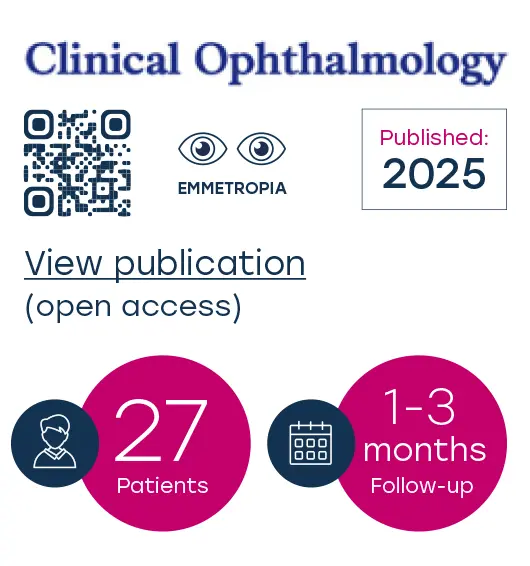
Visual and refractive outcomes after bilateral implantation of an enhanced monofocal intraocular lens: prospective study
Authors: Javier García-Bella, Bárbara Burgos-Blasco, Beatriz Vidal-Villegas, Nuria Garzón, Celia Villanueva, Julián García-Feijoo. Key takeaways:
- 25 patients with binocular implantation of RayOne EMV with emmetropic targeting.
- Uncorrected intermediate: 59% of patients could read ≤0.1 and 100% ≤0.2 logMAR.
- Binocular defocus curve demonstrated a visual acuity of ≤0.2 logMAR over more
- than 2.0 D range (from +1.00 D to -1.25 D).
- Mean monocular CDVA was -0.03 ± 0.06 logMAR (better than 6/6).
- Satisfaction was rated good by 96% of patients.
Clinical Outcomes and in vivo Aberrometry Following the Implantation of a Monofocal IOL with Positive Aspherici
Authors: Arthur van den Berg, Roberta van den Berg, Wallace Chamon, Karolinne Rocha. Key takeaways:
- Wavefront analysis of eyes implanted with RayOne EMV suggests that the IOL’s positive
- spherical aberration profile complemented the pre-existing corneal spherical aberrations.
- 100% of eyes had mean monocular CDVA of 20/25 or better.
- Mean monocular DCIVA was 0.19 logMAR and DCNVA was 0.24 logMAR.

Visual Performance and Subjective Outcomes with Enhanced Monofocal Intraocular Lens Implantation Targeted for Emmetropia or Modest Monovision
Authors: Tun Kuan Yeo, Don Chern Kuok Pek, John Xin Hao Wong. Key takeaways:
- In the emmetropia group (n = 30), the mean logMAR UDVA, UIVA and UNVA were 0.16±0.13,0.35±0.12 and 0.50±0.15.
- In the monovision group (n = 30), the values for the distance eyes were 0.13±0.11, 0.40±0.11 and 0.56±0.13; and for the near eyes 0.41±0.21, 0.27±0.16 and 0.34±0.13 logMAR.
- Binocular defocus curves showed similar distance visual acuity but better visual acuity in the monovision group from –1.00 D to –4.00 D and −1.00 D to –3.50 D defocus under photopic and mesopic conditions respectively (p < 0.05).
- The defocus range (logMAR 0.2 or better) was 1.3 D for the bilateral emmetropia group and 2.5 D for the monovision group.
- Visual acuities at 0.0 D, −1.0 D and −1.5D defocus had no linear correlation with pupil size (p > 0.05) in both groups.
- 90% (emmetropia group) and 96% (monovision group) of patients were very or fairly satisfied with their vision, with the monovision group reporting better performance for intermediate and near tasks.

Visual outcomes, contrast sensitivity, and defocus profile with an aspheric monofocal intraocular lens using positive spherical aberration
Authors: Elizabeth Law, Rajesh Aggarwal, Phillip Buckhurst. Key takeaways:
- RayOne EMV with -0.5 D to -1.0 D target in the non-dominant eye for monovision is a reliable method for improving intermediate and near visual acuity, by increasing the range of focus without compromising distance vision or contrast sensitivity.
- Contrast sensitivity showed no significant difference between dominant and non-dominant eyes (p = 0.06).
- Significant improvement binocularly compared to monocularly was seen in the defocus curve from -0.5 to -2.5 D.

Patient satisfaction and quality of vision after bilateral implantation of enhanced monofocal IOL and mini-monovision: a prospective study
Authors: Andrea Llovet-Rausell, Jorge Navalón-Tortosa, Vasyl Druchkiv, Javier Coloma-Bockos, Jaime Moya-Roca & Fernando Llovet-Osuna. Key takeaways:
- 51 Patients had RayOne EMV with -1.0 D monovision in the non-dominant eye.
- Three months postop, all patients were satisfied or very satisfied, with 95% reporting night driving was as good or better than before surgery.
- Contrast sensitivity was within population norms (CSV-1000).
- Monovision with RayOne EMV provides high patient satisfaction, with preservedcontrast sensitivity and high-quality night vision

The Influence of the Level of Monovision upon Early Outcomes Following the Bilateral Implantation of an Enhanced Monovision Intraocular Lens
Authors Richard N. McNeely, Stephen Stewart, Niraj Mandal, Salissou Moutari, Allon Barsam, Jonathan E. Moore. Key takeaways:
- RayOne EMV with -0.5 to -1.0 D or beyond -1.0 D in the non-dominant eye for monovision provided similar binocular uncorrected visual acuity at distance.
- Better intermediate and near vision and higher spectacle independence rate in the group with more than -1.0 D in the non-dominant eye with no impact on dysphotopsia, binocular contrast sensitivity or stereopsis.

Monocular and Binocular Visual outcomes of an Enhanced Monofocal (Mono-EDOF) Intraocular Lens and the Impact of Pre-Operative Parameters
Author: David Gunn. Key takeaways:
- 147 eyes receiving RayOne EMV or EMV Toric with various levels of monovision.
- Level of corneal Spherical Aberration (SA) was not correlated with the VA outcomes for distance or near: The high SA group did just as well as the low SA group.
- CW-Chord (similar to Angle Kappa) was not correlated with VA outcomes for distance or near: The higher CW-Chord group did just as well as the lower CW-Chord group.
- Higher Corneal HOAs correlated with slightly lower CDVA, as would be expected with any monofocal IOL: Mean CDVA was still 0 LogMAR (6/6) in the high HOA group.

Clinical Performance of an Enhanced Monofocal IOL Bilaterally Implanted in Patients Targeted for Monovision: A Prospective Study
Author: Javier García-Bella, Celia Villanueva, Nuria Garzón, Bárbara Burgos-Blasco, Beatriz Vidal-Villegas, Julián García-Feijoo. Key takeaways:
- In the non-dominant eyes, mean monocular UIVA was 0.11 ± 0.11 logMAR at 80 cm and 0.11 ± 0.09 logMAR at 66 cm.
- Mean binocular UIVA was slightly better than monocular non-dominant eyes with 0.07 ± 0.09 logMAR at 80 cm and 0.08 ± 0.08 logMAR at 66 cm, indicating monovision enhancement with binocular summation effect.
- Binocular UIVA at 80 cm was 0.1 logMAR or better in 71.4% of patients and 0.3 logMAR or better in all patients; at 66 cm was 0.1 logMAR or better in 64.3% of patients and 0.3 logMAR or better in all patients.
- There was no statistically significant difference in binocular UIVA between 66 cm and 80 cm (p = 0.294).
- Overall, 90% of patients reported no vision-related difficulties in their everyday life.

Comparing an Advanced Monofocal With a Non-diffractive Extended Depth of Focus Intraocular Lens Using a Mini-Monovision Approach
Author: Johannes Zeilinger, Martin Kronschläger, Andreas Schlatter, Stefan Georgiev, Manuel Ruiss, Caroline Pilwachs, Oliver Findl. Key takeaways:
• With mini-monovision (-0.5 D in the non-dominant eye targeted in both groups), RayOne EMV showed similar binocular UDVA, UIVA and UNVA compared to the Acrysof IQ Vivity, despite a smaller average offset in the RayOne EMV group.
• RayOne EMV showed significantly smaller halo size than Acrysof IQ Vivity (p < 0.01).
• Contrast sensitivity was (slightly) better in the RayOne EMV group especially under mesopic conditions, with glare comparable to the Acrysof IQ Vivity.

Clinical Outcomes of Enhanced Monofocal (Mono-EDOF) Intraocular Lenses with the Mini-Monovision Technique versus Trifocal Intraocular Lenses: A Comparative Study
Authors: Izzet Can, Hasan Ali Bayhan. Key takeaways:
- RayOne EMV with -0.7 D monovision provided similar visual acuity at all distances but less dysphotopsia than the PanOptix diffractive trifocal IOL:
- No difference was seen in binocular uncorrected visual acuities in the RayOne EMV and PanOptix groups (p > 0.05).
- Contrast sensitivity was statistically significantly better in the RayOne EMV group at all spatial frequencies (p < 0.05).
Overall conclusion for the EMV peer-reviewed publications:
Patients targeted for bilateral emmetropia achieve good functional intermediate vision, while those with monovision experience enhanced intermediate and near vision.
Patients report high satisfaction and good visual performance when implanted with the increased range of focus IOL.